
Beyond RAG: How Model Context Protocol Enables Grounded AI for Healthcare Payers

AI agents in regulated industries face a problem that RAG alone doesn't solve: the data they need to act on isn't static. In a typical healthcare payer environment, data is live, fragmented across systems, and must remain auditable to a source of record. That gap is exactly what Model Context Protocol (MCP) was built to close.

What is MCP - and why does it matter for healthcare AI?

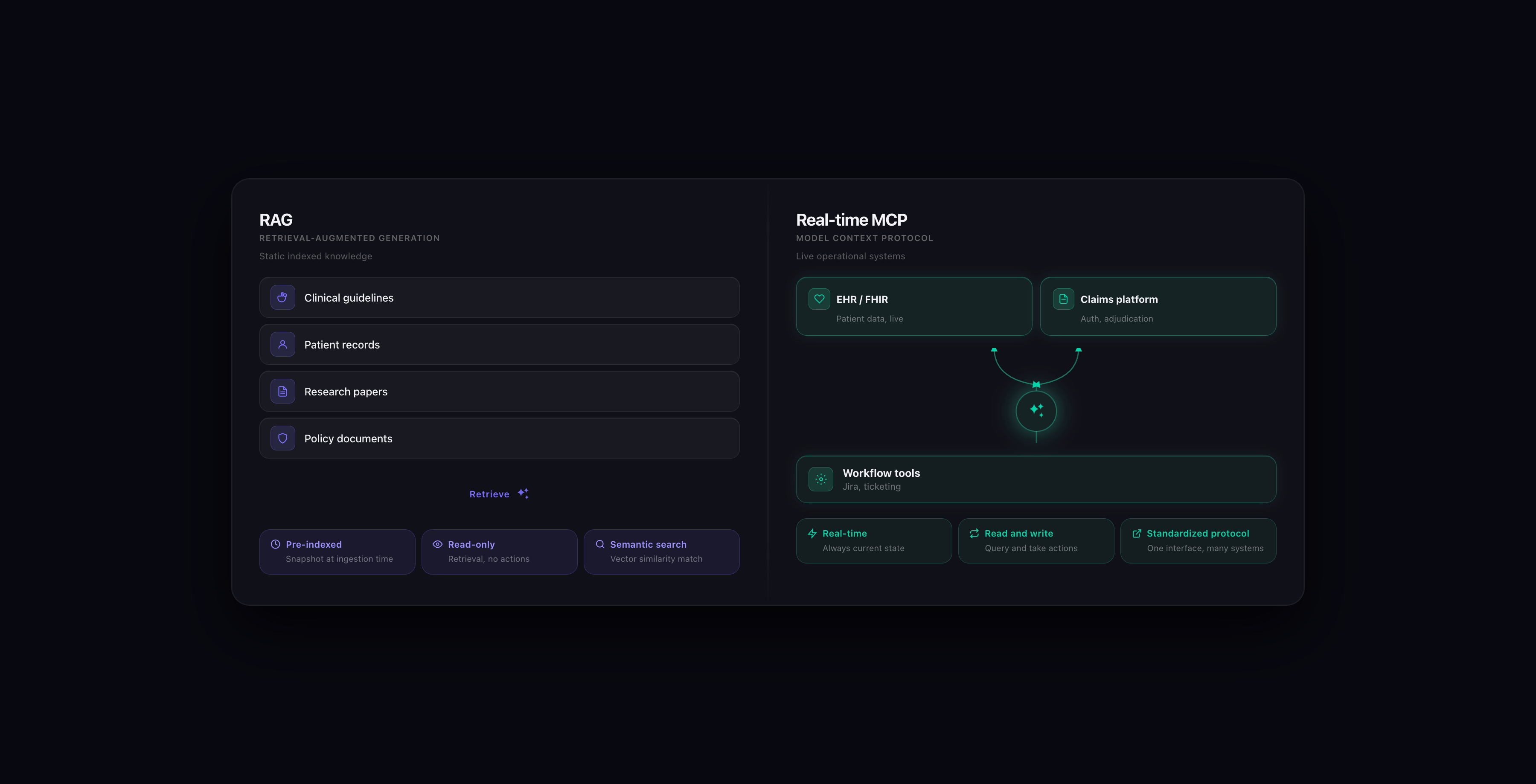
Model Context Protocol (MCP) is an open standard that gives healthcare payer AI agents a secure, structured way to query live source systems rather than reasoning over a pre-indexed knowledge base. Think of it as a universal adapter layer between an AI agent and the enterprise systems it needs to act on: EHRs, claims platforms, care management tools, and beyond.

At Everlign, we built our MCP layer as a YAML-configured connector framework, allowing our team to plug into a client's existing stack in days, not months. Each integration, whether that's a FHIR AI integration, Salesforce, ServiceNow, or Jira, is defined as a lightweight YAML file. Adding a new data source requires no new containers and no redeployment, making the architecture extensible across organizations with diverse tech stacks.

Where RAG falls short in regulated environments

Standard RAG works well for knowledge retrieval over static documents. It breaks down in regulated environments where freshness matters, auditability is required, and multi-system reasoning is the norm. For healthcare payer AI agents specifically, vector indexes updated nightly miss same-day changes in claims status or clinical records causing a critical failure point in workflows like AI prior authorization software or revenue cycle AI automation.

MCP addresses these gaps by giving agents live read access to governed systems at query time, with a full trace of every call made and every result returned.

A practical example: HEDIS gap closure for healthcare payers

Consider HEDIS gap closure in healthcare payer workflows. Our HIPAA compliant AI platform queries FHIR endpoints for clinical evidence and care management platforms for open outreach activity all in a single agent action. Every recommendation is linked back to the source query that grounded it, satisfying NCQA audit requirements without manual reconciliation.

This pattern extends wherever data freshness and auditability are non-negotiable: government case management, financial compliance, defense logistics. Anywhere a wrong answer carries real consequences.

Conclusion

RAG is a powerful starting point. But in environments where the cost of a wrong answer is high, and where regulators, auditors, and NCQA reviewers demand traceability, agents need live access to authoritative systems, not stale indexes. That's what MCP delivers. That's what we built Everlign around.

Ready to see how Everlign's MCP layer connects to your existing payer stack Contact us to learn more.
Background

AI agents in regulated industries face a problem that RAG alone doesn't solve: the data they need to act on isn't static. In a typical healthcare payer environment, data is live, fragmented across systems, and must remain auditable to a source of record. That gap is exactly what Model Context Protocol (MCP) was built to close.

What is MCP - and why does it matter for healthcare AI?

Model Context Protocol (MCP) is an open standard that gives healthcare payer AI agents a secure, structured way to query live source systems rather than reasoning over a pre-indexed knowledge base. Think of it as a universal adapter layer between an AI agent and the enterprise systems it needs to act on: EHRs, claims platforms, care management tools, and beyond.

At Everlign, we built our MCP layer as a YAML-configured connector framework, allowing our team to plug into a client's existing stack in days, not months. Each integration, whether that's a FHIR AI integration, Salesforce, ServiceNow, or Jira, is defined as a lightweight YAML file. Adding a new data source requires no new containers and no redeployment, making the architecture extensible across organizations with diverse tech stacks.

Where RAG falls short in regulated environments

Background

What’s a Rich Text element?

The rich text element allows you to create and format headings, paragraphs, blockquotes, images, and video all in one place instead of having to add and format them individually. Just double-click and easily create content.

Static and dynamic content editing

A rich text element can be used with static or dynamic content. For static content, just drop it into any page and begin editing. For dynamic content, add a rich text field to any collection and then connect a rich text element to that field in the settings panel. Voila!

How to customize formatting for each rich text

Headings, paragraphs, blockquotes, figures, images, and figure captions can all be styled after a class is added to the rich text element using the "When inside of" nested selector system.

Situation

Standard RAG works well for knowledge retrieval over static documents. It breaks down in regulated environments where freshness matters, auditability is required, and multi-system reasoning is the norm. For healthcare payer AI agents specifically, vector indexes updated nightly miss same-day changes in claims status or clinical records causing a critical failure point in workflows like AI prior authorization software or revenue cycle AI automation.

MCP addresses these gaps by giving agents live read access to governed systems at query time, with a full trace of every call made and every result returned.

A practical example: HEDIS gap closure for healthcare payers

Consider HEDIS gap closure in healthcare payer workflows. Our HIPAA compliant AI platform queries FHIR endpoints for clinical evidence and care management platforms for open outreach activity all in a single agent action. Every recommendation is linked back to the source query that grounded it, satisfying NCQA audit requirements without manual reconciliation.

This pattern extends wherever data freshness and auditability are non-negotiable: government case management, financial compliance, defense logistics. Anywhere a wrong answer carries real consequences.

Conclusion

RAG is a powerful starting point. But in environments where the cost of a wrong answer is high, and where regulators, auditors, and NCQA reviewers demand traceability, agents need live access to authoritative systems, not stale indexes. That's what MCP delivers. That's what we built Everlign around.

Ready to see how Everlign's MCP layer connects to your existing payer stack Contact us to learn more.

Situation

Solution

Results

Types of Journeys

Tech Stack